- The NawLaw Report
- Posts
- NawLaw News: This Week's Highlights
NawLaw News: This Week's Highlights
Welcome Back! 👋🏼
Dear Readers,
Welcome back to NawLaw Immigration News, where we bring you updates and announcements from the Firm, as well as the latest news in the rapidly changing U.S. immigration world. With President Trump’s second term, there’s no been no shortage of activity, including frequent policy changes and ongoing legal battles. Let’s get you caught up!
Table of Contents
Federal Judge Deals ‘Major Blow’ to Trump’s Agenda in Ruling with Nationwide Implications
A federal judge recently ruled that the Trump administration unlawfully arrested and detained hundreds of immigrants across the country and ordered their release by November 21. Judge Jeffrey Cummings noted that more than 600 people in custody had no deportation orders and no criminal history, highlighting the unlawfulness of the mass arrests. Plaintiffs’ attorneys argued that many immigrants voluntarily left the U.S. after being detained, but the ruling confirmed that the majority of arrests in Chicago and elsewhere were illegal. Attorney Mark Fleming described the administration’s tactics under ICE and Border Patrol leadership as terrorizing and unlawful, reinforcing the court’s decision. The Department of Homeland Security has not yet indicated whether it will appeal, though discussions with the Solicitor General may occur. Observers suggest the ruling could have nationwide implications, potentially influencing other similar cases across the country and setting a precedent against improper immigration detentions.

Photo by Neil Weinrib
State Department Allows Denial of Immigrant Visas to Those With Certain Medical Conditions
The U.S. Department of State has released an internal directive instructing consular officers to assess whether immigrant visa applicants have medical conditions that could require expensive long-term care and thus raise the risk of them becoming a “public charge.” The guidance lists conditions such as cardiovascular and respiratory diseases, cancers, diabetes, metabolic and neurological disorders, and mental-health conditions, and even mentions obesity as a factor that could trigger additional scrutiny. The directive also asks officers to evaluate whether the applicant (and their dependents) can cover the projected medical costs over their expected lifetime without relying on public assistance or long-term institutional care. Although visa applicants already undergo medical exams for communicable diseases and required vaccinations, this policy broadens the focus to common chronic conditions and future medical cost-risks. A State Department official emphasized that having a particular medical diagnosis does not automatically result in denial; the approach remains case-by-case, based on the overall impact of the person’s health, finances, and dependents. Immigration advocates express concern that the expanded medical criteria could add significant unpredictability and potential bias into visa adjudications.

Photo by Neil Weinrib
CBP Rolls Out Facial Recognition App to Help Local Police to Stop Illegal Immigrants
The U.S. Customs and Border Protection (CBP) has rolled out a mobile face-scanning app called Mobile Identify for state and local law-enforcement agencies that work under immigration-enforcement partnerships. The app allows officers in the field to capture a person’s facial image and run a check, which then returns a reference number and instructions to contact U.S. Immigration and Customs Enforcement (ICE) if the individual may be unlawfully present — it does not itself return the person’s name. Code-analysis of the app finds references to modules like “facescanner” and “FacePresence,” suggesting built-in facial-recognition functionality. Although the app is tied to the Immigration and Nationality Act (INA) § 287(g) program that deputizes local officers for certain immigration tasks, key technical and policy details — such as what database images are being compared, how long data are retained, and whether U.S. citizens might be affected — remain unclear. Civil-liberties advocates warn that deploying such surveillance technology at the local-police level could lead to wrongful detentions, racial bias, and erosion of due-process protections. The rollout marks a further expansion of DHS’s biometric enforcement network into routine local policing, raising serious questions about oversight, accuracy, and accountability.

Photo by Max Klebba
USCIS Proposes Major Expansion in Biometrics Collection for Immigration Processing
USCIS and the Department of Homeland Security have introduced a proposed rule that would greatly expand the collection of biometric data from individuals involved in immigration benefit requests. The proposal removes age-based exemptions and would allow DHS to require biometrics from children under 14, as well as U.S. citizens, nationals, and lawful permanent residents connected to certain filings. It also broadens the definition of biometrics to include facial images, palm prints, voice prints, and potentially DNA analysis. DHS estimates that the annual number of biometric submissions would rise by more than a million under the new rule. The agency argues that the expansion would strengthen identity verification, prevent fraud, and enhance national security screening. Critics, however, warn that the proposal raises significant privacy and civil-liberty concerns due to the scope and sensitivity of the data collected.

Photo by Neil Weinrib
H-1B Visas for Existing F-1 Student in the US Will Not Trigger a $100K Fee for Employers
The U.S. government clarified that the new $100,000 fee for the H‑1B visa petition does not apply when a U.S. employer sponsors a student currently in the U.S. on a F‑1 visa (including those on Optional Practical Training) to change status to H-1B via a “change of status” petition. The exemption is valid when the petition is filed while the student remains inside the U.S., rather than for petitions involving departure and re-entry through consular processing. The $100K fee still applies for new H-1B petitions filed on behalf of beneficiaries outside the U.S. starting on or after September 21, 2025. For employers, this means hiring recent U.S. graduates on F-1/OPT and filing for a change of status to H-1B avoids the extra fee cost. However, if the beneficiary is abroad at the time of filing, or the petition requires consular processing, the fee may still apply unless a narrow waiver is granted. The update is already changing recruiting behavior, with many U.S. firms focusing more on candidates already in the U.S. to avoid the added cost.

Photo by Neil Weinrib
TPS and U-Visa Do Not Count as ‘Admission’ for Green Card Eligibility Under INA 245(a), USCIS Clarifies in New Policy Alert
The U.S. Citizenship and Immigration Services (USCIS) issued a policy alert on November 3, 2025 clarifying that obtaining Temporary Protected Status (TPS) or status under the U nonimmigrant visa (U visa) does not count as being “inspected and admitted” into the U.S. for purposes of adjusting status under section 245(a) of the Immigration and Nationality Act (INA). This aligns USCIS’s policy with the Sanchez v. Mayorkas Supreme Court decision, which held that TPS does not by itself confer admission. The guidance emphasizes that status (like TPS or U visa) is distinct from lawful admission via inspection and entry by an immigration officer, and thus grants of those statuses inside the U.S. do not automatically meet the requirement. USCIS notes that U visa holders who entered lawfully (inspected and admitted) may still adjust under INA 245(a), but those who obtained U status after an unlawful entry cannot rely on U status alone. For TPS holders, they may still be eligible under INA 245(a) only if they separately meet the “inspected and admitted or inspected and paroled” requirement—such as by re-entering with authorized travel and inspection. The update makes clear that prior inconsistent adjudications are being corrected, and immigration applicants with TPS or U visa status should review their entry history and consult qualified counsel about alternative pathways to permanent residence.

Photo by Max Klebba
Exciting Events at NawLaw: Stay Informed and Engaged!
Neil and Kim with Long-Time Friends Dr. Lanny Schwartzfarb and his wife, Robin Rothman

Photos Taken By Neil at the Sotheby’s Art Auction
 |  |
 |   |
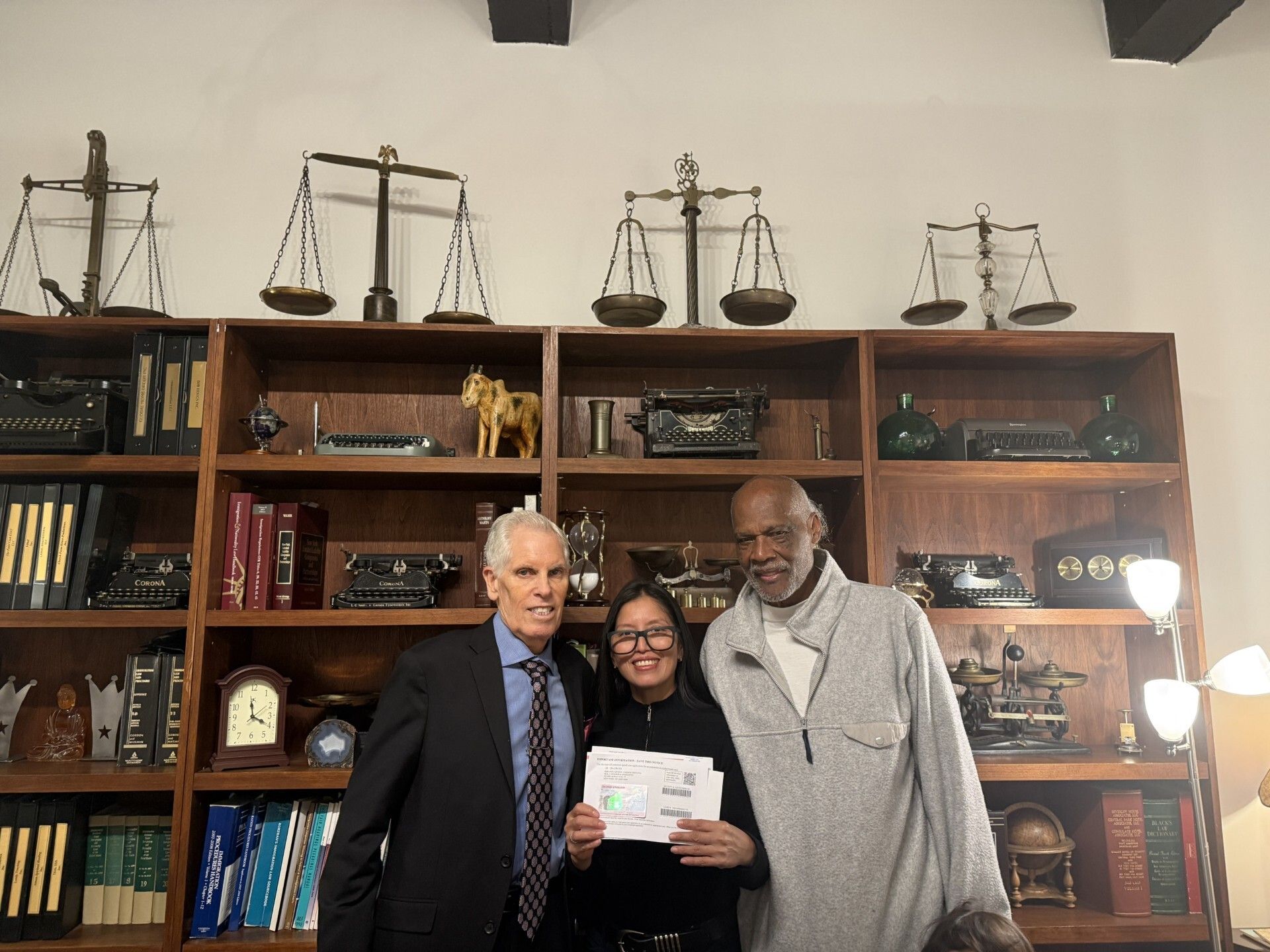
Congratulations to our NawLaw Clients who’ve Received their Green Cards and Work Permits! 🎉
We’re so proud to be part of your journey and celebrate this huge milestone with you!
Here’s to new beginnings and endless opportunities!
🌟🌟🌟🌟




Don’t forget to follow us on TikTok, Instagram, and Facebook! 📣
@neilweinrib Courts blocked Trump’s National Guard deployments and federal worker layoffs. Supreme Court upheld H-4 visa work rights. Lawsuit challenge... See more
@neilweinrib USCIS launched a new asylum fee system but advises applicants to wait before paying. A judge blocked Trump from sending the National Guard... See more
We Are Your Trusted Source for U.S. Immigration!
For over 40 years, NawLaw has built its winning reputation based on obtaining terrific results, unrivaled expertise, personalized service, sensitivity to the needs of our clients, and, most importantly, achieving tremendous success! Our expertise and reputation for success speak for themselves! NawLaw is proud to be a trusted law firm as well as a leading force and “X” factor for foreign nationals and investors interested in studying, living, and working in the U.S., companies in the U.S. seeking their services, and companies abroad seeking to transfer key personnel to the U.S. We are proud to be regarded as the “go-to law firm” for U.S. immigration! Our reputation as the “go to” immigration law firm is based on our unwavering commitment to achieving exceptional client results and providing outstanding, personalized service. Given the many challenges immigrants face in the U.S., we are lawyers you can trust to get the results you want! There is no substitute for experience!
We Are Lawyers You Can Trust – We Change People’s Lives!
NawLaw Provides Urgent Care in U.S. Immigration and Winning Legal Solutions!
Call us today or Visit Our Website to get your immigration process started! And check out our social media updates on Twitter, Instagram, Facebook, and YouTube.
Call us 212-964-9282
Email us: [email protected]

Immigration Done Right!